
New Highs, Higher Yields, and a Weaker Dollar. Can All Three Persist?

Nasdaq, S&P Post First Monthly Gain Since May
_______________________________________________________________________
Despite renewed inflation and deficit concerns, ongoing geopolitical conflict, and a hawkish tone from Chair Warsh at Jackson Hole, equities moved higher in August, supported by a rebound in mega-cap technology. The Nasdaq Composite gained 4.0% and the S&P 500 rose 2.7%, each posting its first monthly advance since May, while both the S&P 500 and the Dow Jones Industrial Average reached record highs during the month. Emerging market and international developed equities led (+3.3% each), followed by US growth (+3.2%). Aside from municipal bonds (-0.2%), fixed income was mostly higher as high yield credits rose 1.0%, investment grade corporate bonds gained 0.4%, and the US Aggregate Bond Index increased 0.3%. Commodities produced positive returns as silver surged 14.8%, gold gained 9.9%, broad-based commodities rose 7.4%, and crude oil increased 3.5%.
Warsh Turns Hawkish at Jackson Hole
_______________________________________________________________________
At his first Jackson Hole symposium as Fed Chair, Kevin Warsh struck a distinctly hawkish tone, putting price stability at the center of the Fed's mandate and recommitting to its 2% inflation target. "It is the Fed's job to deliver stable prices, no excuses," he said, calling the goal a firm and fixed target. He described the employment side of the mandate as in good shape, viewing the labor market as consistent with full employment at a 4.1% jobless rate and attributing soft job gains to slow labor-supply growth rather than weakening demand. He also struck an optimistic note on growth, citing faster-than-expected progress in AI as lifting the economy's potential. Inflation was his central concern. Summer readings had come in cooler, with July CPI at 3.4% year-over-year and core CPI easing to 2.5%, but the Fed's preferred gauge stayed firmer, as headline PCE ran 3.7% and core PCE 3.3%, both well above the 2% target. Warsh seized on that gap, noting that "while this summer's readings were better than expected, they do not tell me that underlying trends have meaningfully improved," and warned the Fed would have "work to do" if it could not be confident inflation was heading back to its goal. As he has at every meeting since taking office, Warsh declined to offer forward guidance, arguing that pre-committing to a rate path narrows the Fed's room to maneuver. Markets moved quickly, as short-term yields moved higher while longer-term yields declined, flattening the curve. Ahead of the September FOMC meeting, the CME FedWatch Tool had assigned roughly a 70% probability to a hold before the speech. Markets now price a roughly 66% chance of a hike.
The Treasury Steps in as Yields Climb
__________________________________________________________________________________________________________________________________________
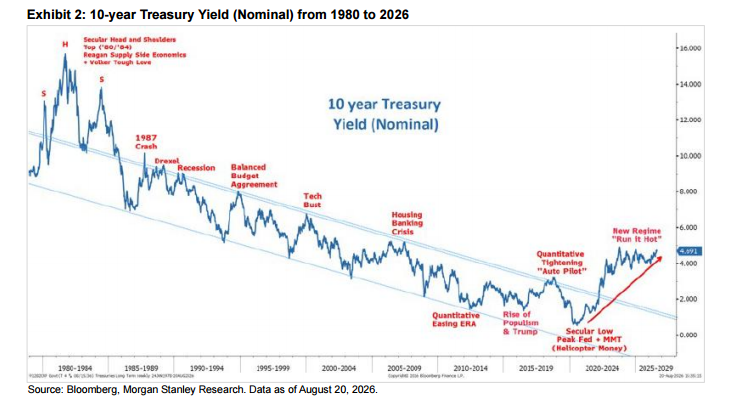
The broader backdrop for markets is a shift in the bond-market regime. After nearly four decades of generally falling interest rates, the long secular decline in Treasury yields has reversed since 2020, and that shift was on display this month as the 10-year yield reached topped 4.75%, its highest level since 2007 (Exhibit 2). The move reflects persistent inflation, higher oil prices, and growing attention to the federal government's borrowing needs. In response, the Treasury announced on August 19 that it would at least double its long-dated bond buybacks, from $2 billion to $4 billion per operation, funded through shorter-term bill issuance and the Treasury General Account. These buybacks are meant to support liquidity by purchasing older, less-traded securities, and while they change the composition of Treasury debt and add a source of demand for long-duration bonds, they do not reduce the government's overall borrowing needs or debt outstanding. The effect resembles quantitative easing (QE) in supporting bond demand, though unlike QE, it does not expand the Fed's balance sheet. The concern is that holding down long-term yields without fixing the fiscal imbalance doesn't make the problem go away. It moves from the bond market to the dollar. If yields are held below what investors would otherwise demand, foreign holders are compensated less for inflation and fiscal risk, which can weigh on the value of the dollar. And this buyback is bringing the debasement trade back into focus. That was evident after the announcement, when a softer dollar drew investors toward assets often seen as a store of value, lifting gold to a three-month high near $4,700 an ounce and Bitcoin back above $80,000 mark.
Why a Falling Jobless Rate May Be Sending the Wrong Signal
_________________________________________________________________________________________________________________________________________
On the surface, July's employment report looked healthy, with the unemployment rate falling to 4.1%. The improvement, however, came from the wrong place. The economy actually shed 23,000 jobs, and the jobless rate declined mainly because roughly 264,000 people left the labor force altogether. Because the unemployment rate counts only those working or actively looking for work, people who stop looking drop out of the calculation and the rate falls. Participation slipped to 61.4% and the employment-to-population ratio to 58.9%, among the lowest readings outside the pandemic since the 1970s. Much of this decline appears structural rather than cyclical, and a key driver is demographic. As the large baby-boomer generation moves into retirement, the labor force participation rate of workers aged 55 and older has turned lower, pulling down the overall figure (Exhibit 3). The Bureau of Labor Statistics had projected participation to decline only gradually, from 62.6% in 2024 to 61.1% by 2034, yet the economy has reached that level roughly eight years early, as this aging of the workforce combines with tighter immigration and the early effects of labor-displacing technology. Even wage growth has been soft against this backdrop, with average hourly earnings up 3.2% year-over-year in July. That is unusual, because a shrinking pool of available workers would normally force employers to compete harder and push pay higher, not lower, which suggests that softer labor demand is offsetting the tighter supply.

Europe Delivers Its Best Earnings Season in Years
__________________________________________________________________________________________________________________________________________
Europe just posted its strongest earnings season in years. Second-quarter profits for the MSCI Europe index rose 14% year over year, and consensus now expects European earnings to grow 17.8% in 2026, or 14.0% excluding Energy. What stands out is the direction of those estimates, which are typically cut as the year progresses, but this year have been revised higher (Exhibit 4). Much of the resilience reflects sector composition. Whereas the Magnificent 7 make up over 30% of the S&P 500, Europe's benchmark is anchored by financials and industrials, which gives it little direct exposure to the debate over AI capital spending while still letting it sell into the buildout through electrical equipment, grid hardware, and turbines. European companies still trail their US peers on profitability, but they are steadily improving their return on equity, margins, and share buybacks. Policy is adding a structural tailwind, as Germany deploys a €500 billion infrastructure fund and lifts defense spending toward 2.8% of GDP. It also helps that European equities and European economy move differently, since its companies earn about 60% of their revenue abroad. That global reach means the earnings story does not hinge on a European recovery, which undercuts one of the longest-standing arguments against the region. Because Europe anchors the international developed ex-US universe, its improvement supports the broader case for developed markets outside the United States, which have lagged US equities for years, trade at a meaningful valuation discount, and carry far less of the concentrated mega-cap AI exposure that now defines the S&P 500. Could this be the start of a broader renaissance for international developed equities, with Europe leading the way?

Warranties & Disclaimers
__________________________________________________________________________________________________________________________________________
There are no warranties implied. Past performance is not indicative of future results. Information presented herein is for educational purposes only and does not intend to make an offer or solicitation for the sale or purchase of any specific securities, investments, or investment strategies. Investments involve risk and, unless otherwise stated, are not guaranteed. The returns in this report are based on data from frequently used indices and ETFs. This information contained herein has been prepared by Astoria Investment Management, previously known as Astoria Portfolio Advisors LLC, on the basis of publicly available information, internally developed data, and other third-party sources believed to be reliable. Astoria Investment Management has not sought to independently verify information obtained from public and third-party sources and makes no representations or warranties as to the accuracy, completeness, or reliability of such information. Astoria Investment Management is a registered investment adviser located in New York. Astoria Investment Management may only transact business in those states in which it is registered or qualifies for an exemption or exclusion from registration requirements
Comments